
Lifeboat Crew Training App
- When
- 2025
- Built with
- Claude
- Status
- Complete
Atlantic 85 Crew Training Application
Every volunteer on an inshore lifeboat works through the same competence framework, from the induction modules you complete before you are allowed near the boat, through to the command qualifications for Helm and Head Launcher. The framework is long and it is examined. The material you need to work through it is not in one place.
It is in a crew handbook, a boat manual, the training standards, a set of standard operating procedures, a separate set of local operating procedures, and assorted PDFs. All of it is accurate. None of it is joined up. Revising a single module meant knowing which document held the procedure and which held the theory, then holding them together in your head. The effort was going into finding the material rather than learning it.
I built this for myself, to stop doing that. I cannot write code; the application was built with Claude, and what that actually involved is further down. Other crew saw me using it and asked for a copy, so I spent longer on it than I had intended to, and circulated it. Several members of the crew have since told me they use it as their main revision resource, which is the only measure of the thing I actually care about.
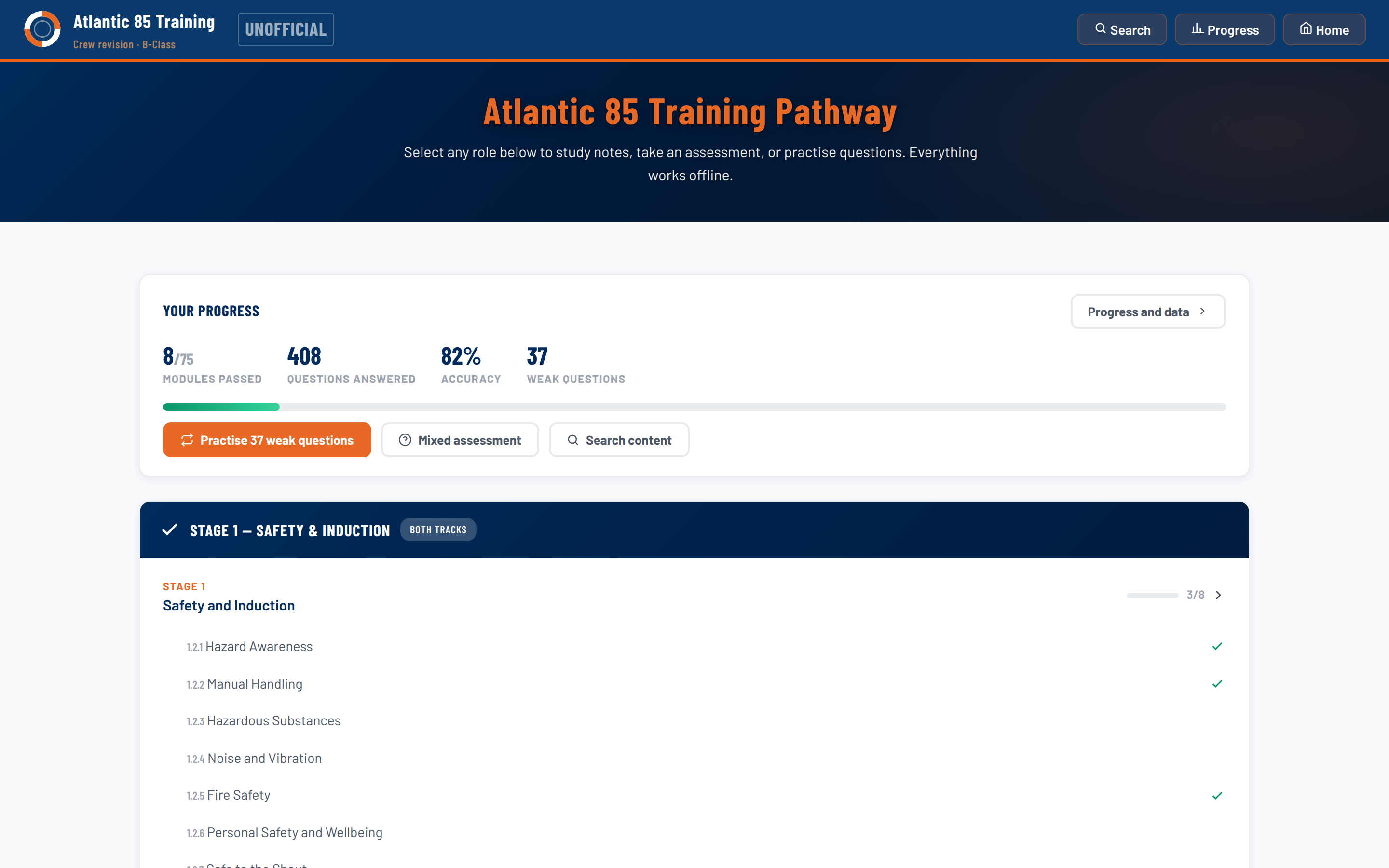
One place, two formats
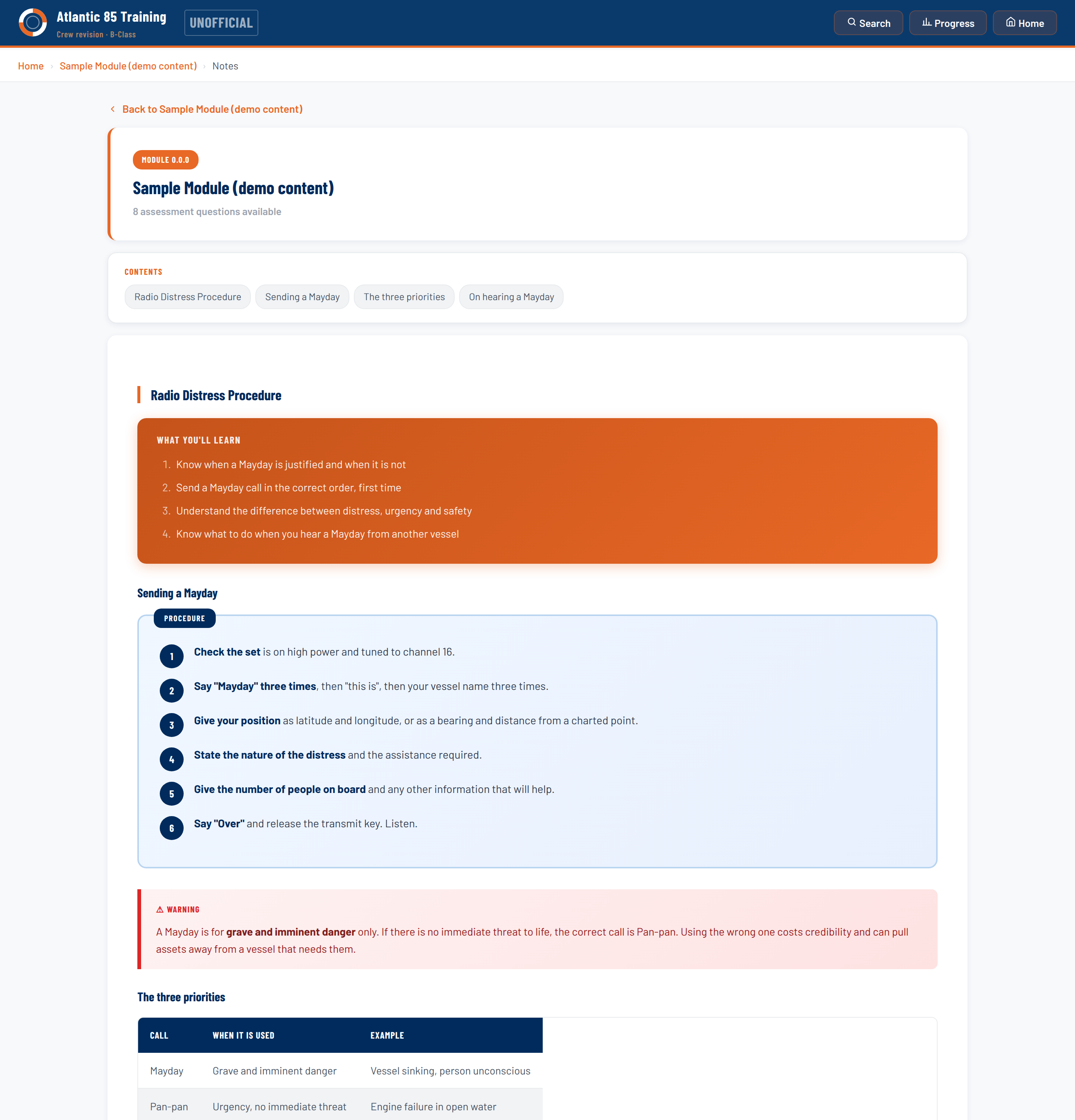
Two tracks, shore crew and boat crew, sharing a common induction stage and running up to Head Launcher on one side and Navigator and Helm Command on the other. Ten roles, seventy-seven modules, 1,797 questions across 75 of them, and roughly 48,000 words of notes across 62. Every module offers the same material two ways: notes to read and learn from, and questions to be tested on, one click apart.
The bulk of the work was not the software. It was reading across the source material for each module and deciding what a crew member actually needs to hold in their head, then reducing it to notes that can be read in a sitting and questions that test the thing rather than the wording. Almost every module’s notes open with what you will learn. Procedures are set out as numbered steps in the order they happen, and the points where getting it wrong matters are flagged as warnings rather than left in the body of the text.
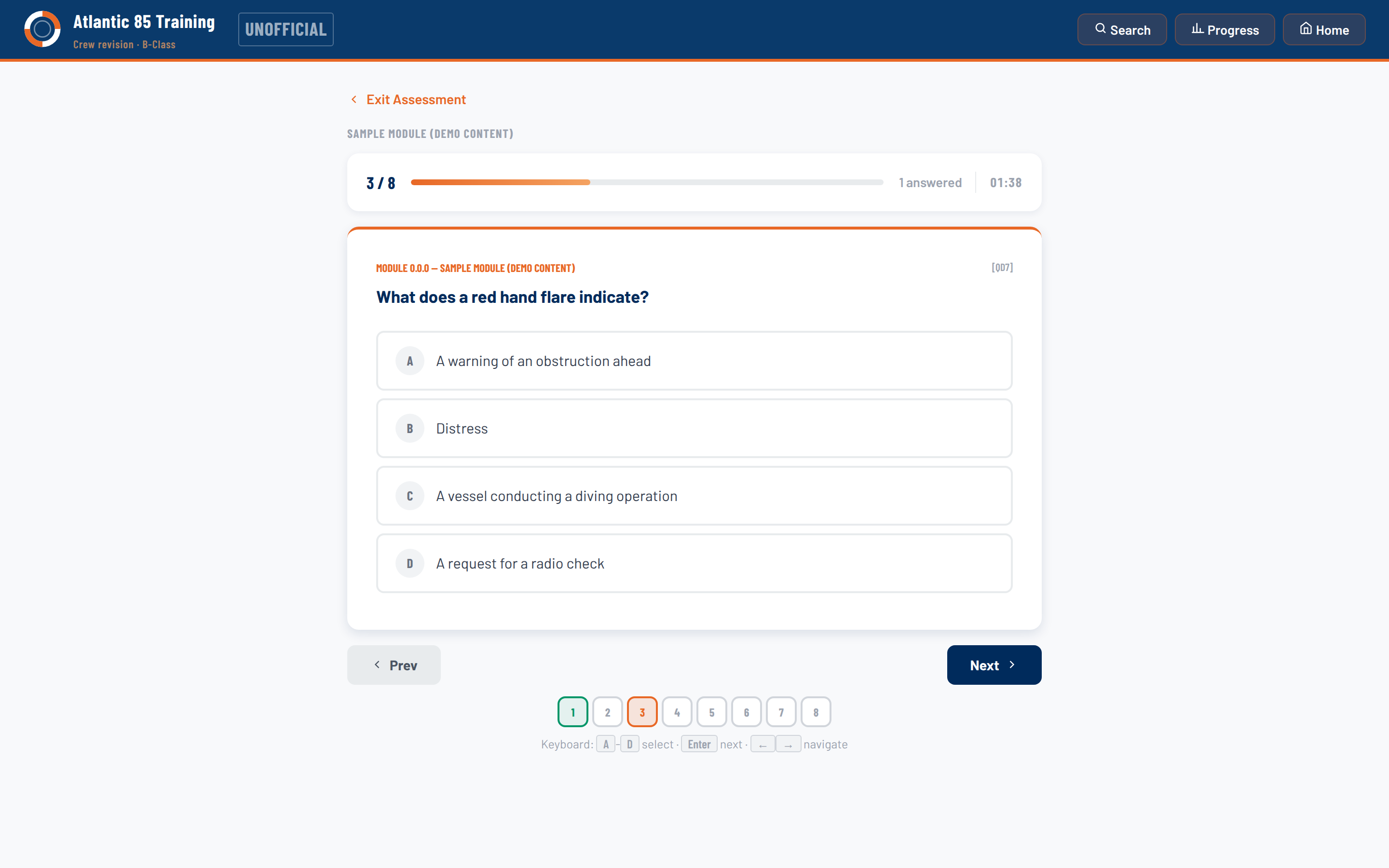
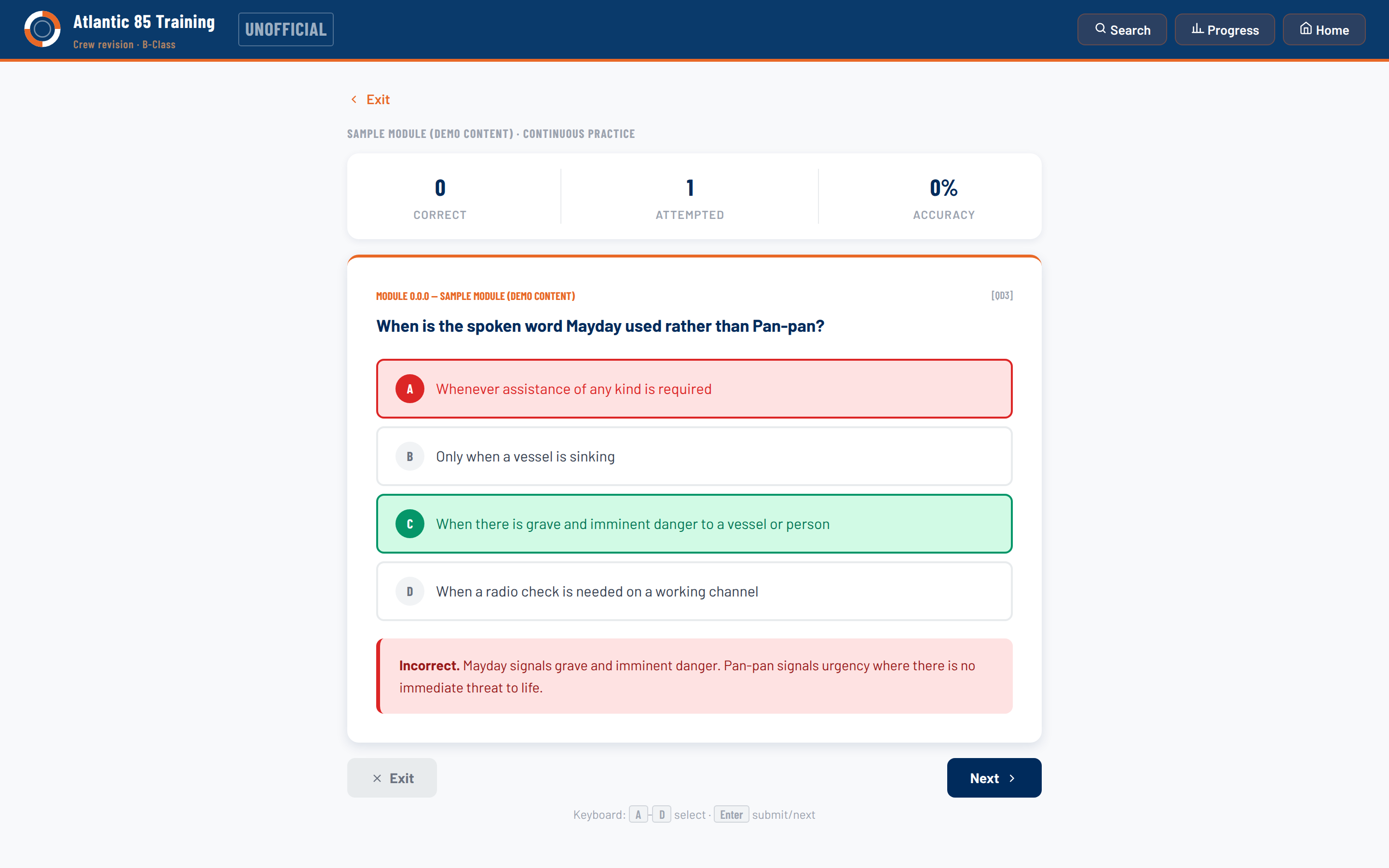
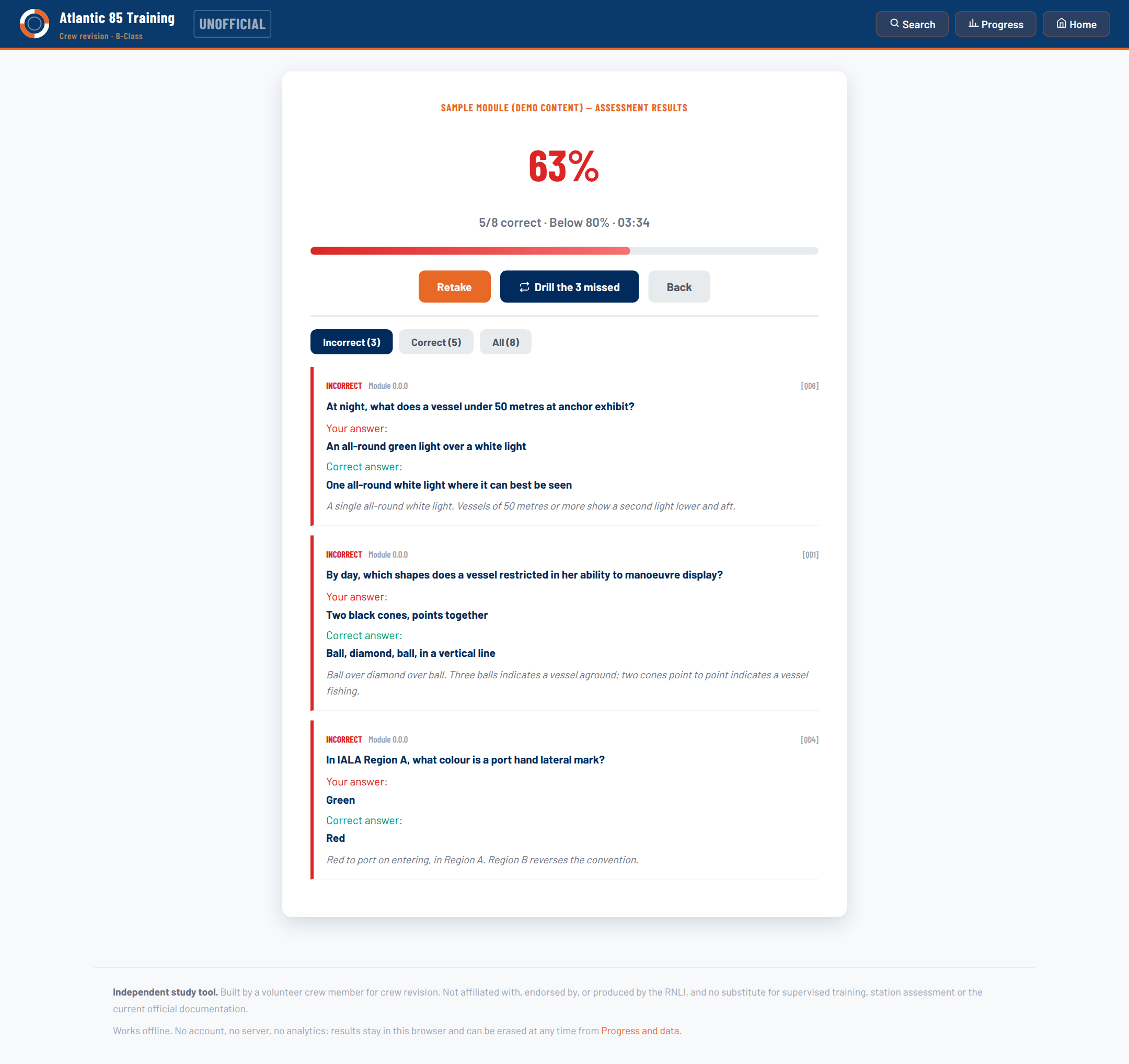
Testing works two ways, because checking and learning are different activities. Assessment gives you a fixed set, marked at the end, with a review screen filtered to the ones you got wrong. Continuous practice is an endless shuffled loop that reveals the answer immediately, which is the mode you want while you are still learning the material. Every one of the 1,797 questions carries a written explanation of why the right answer is right, because a score on its own teaches nothing.
The choices that shaped it
The same structure as the framework itself. Modules keep their numbering and sit under the roles and stages they belong to. You find something by where it sits in your training rather than by remembering which document it was in, which was the whole problem.
Randomising the answers, not just the questions. Both the question order and the lettering of the options are reshuffled on every attempt. Fix the options and after three passes you remember that the answer to question twelve is C, which is not the same as knowing it. The app marks 80% as a pass, a threshold I set to give myself a target rather than something drawn from any formal standard.
Separating content from code. Questions, notes and the pathway definitions sit in three plain data files. Anyone who can edit a text file can correct a question and refresh the browser. That was deliberate: a tool only I can update is a tool that stops being accurate the moment I stop maintaining it.
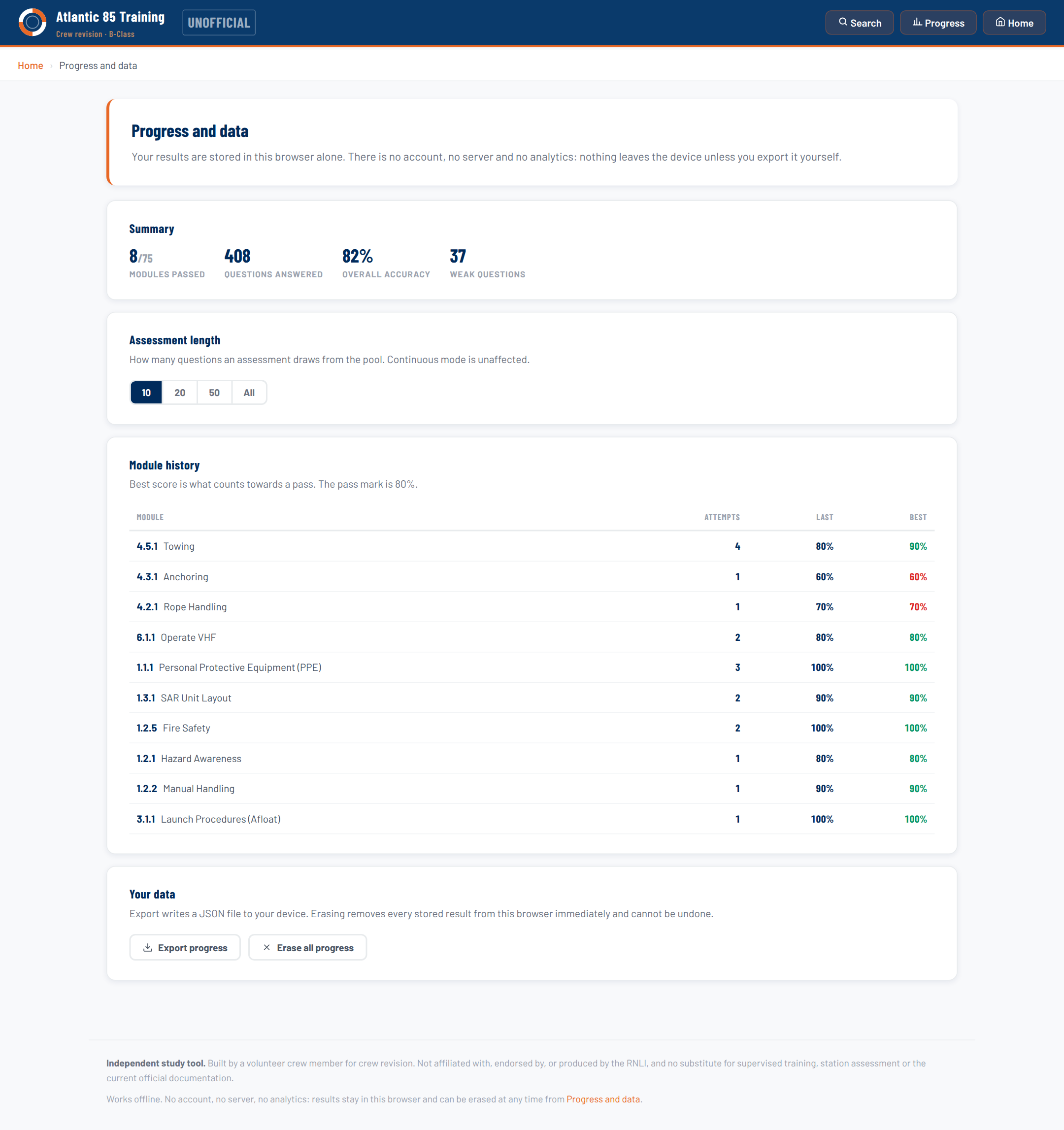
No data collection at all. No account, no server, no analytics. Progress is written to the browser on the device and nowhere else, and there is a page that says so plainly and offers to export or erase it. For something passed around volunteers inside a charity with real data protection obligations, the simplest defensible position was to collect nothing, so that there is nothing to lose.
*Circulated to crew at my own station while data protection policies allowed it. The repository is private. This is an independent project: not affiliated with, endorsed by, or produced by the RNLI, and no substitute for supervised training, station assessment, or the current official documentation. Screenshots use placeholder content drawn from public sources rather than training material.*